Wojciech Fangor
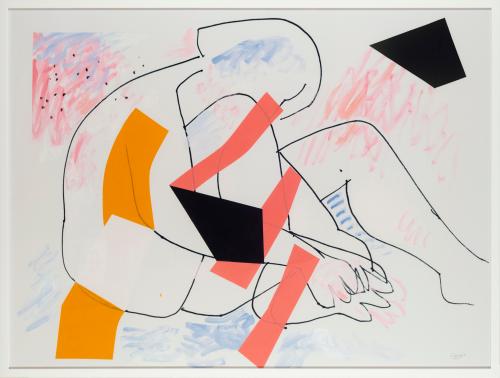
Wojciech Fangor, Pedicure 2, 1990- 2005, mixed media drawing, collage on paper, framed, 121 x 161 cm
Wojciech Fangor (1922–2015) was a leading figure in postwar Polish art and a key precursor to optical and spatial painting. Trained at the Academy of Fine Arts in Warsaw, he initially created works within the framework of Socialist Realism, including prominent public murals that aligned with the ideological expectations of the early postwar years. However, between 1948 and 1956, Fangor’s practice underwent a significant transformation, as he began to question the formal and political limitations of realism.
This transitional period saw Fangor developing a distinct visual language rooted in modernist experimentation. He explored themes of spatial tension, atmospheric color, and the psychological effect of form — elements that gradually distanced his work from narrative. Paintings from this era often reflect an increasing interest in abstraction, perception, and viewer engagement, paving the way for his later innovations in optical art.
Fangor was one of the few Polish artists of his generation who managed to critically engage with official visual culture while simultaneously developing a deeply personal and forward-thinking artistic vision. The works created between 1948 and 1956 are crucial for understanding his trajectory from representational painting to the spatial experiments that culminated in the groundbreaking exhibition A Study of Space (1958) and ultimately led to his international recognition.
Today, Fangor’s early postwar works are seen as essential to the redefinition of Polish modernism in the aftermath of World War II. His art is held in major collections including the Centre Pompidou (Paris), the Solomon R. Guggenheim Museum (New York), and the National Museum in Warsaw.