Bruise, shine on my skin
Polana Institute
to 20.06.2026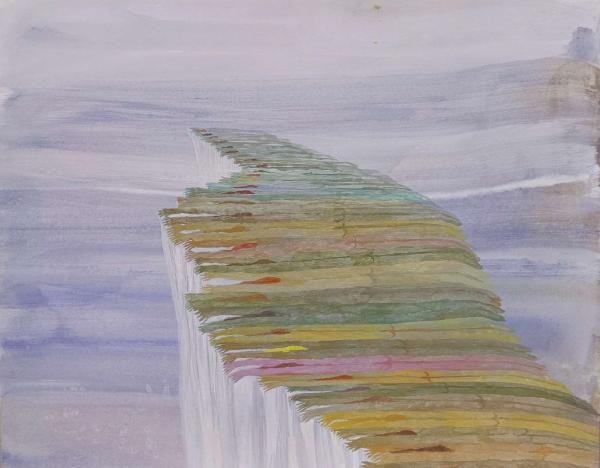
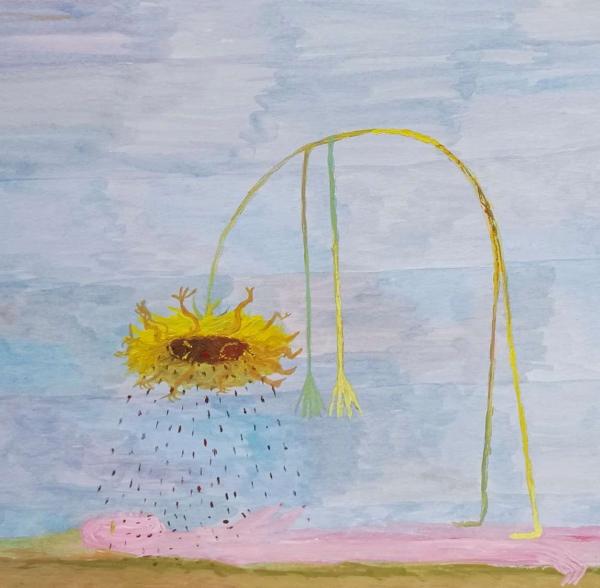
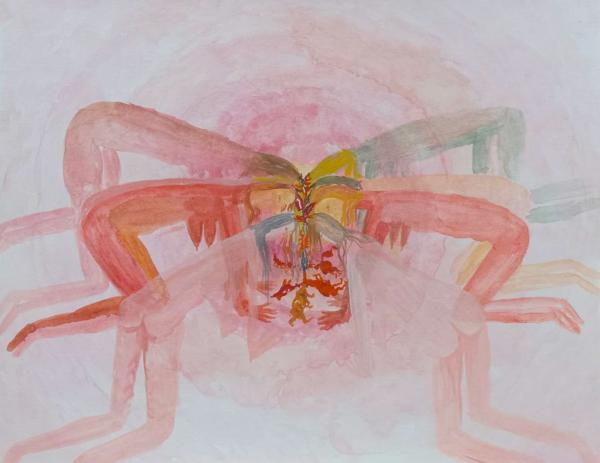
The exhibition by Joanna Fluder at the Polana Institute is a strongly personal narrative about domestic violence, told from the perspective of the skin – or rather, through the wide range of bruises appearing on the body. While understood as a symptom of healing – the gradual resorption of blood diffused within the subcutaneous tissue – they also follow a distinct chromatic sequence imposed by physiology: from red and purple, through blue and green, to yellow. Fluder is interested in the paradox of the bruise’s aesthetic – its ambiguous forms, iridescence, and a certain “beauty” that emerges directly from violence. “A bruise is an attempt at communication by the body, which cries out through colour and form across the skin while the voice remains trapped in the throat.” This biological cycle becomes a language for what cannot be spoken.
A large group of gouaches on paper forms a kind of colourful, bio-derived tapestry. The bruises generate their own layered narratives. Although the imagery recalls children’s literature – marine spirits, anthropomorphic insects, oversized flowers – the titles, each beginning with “bruise in the shape of…”, lend the works a markedly heavier tone. Their close juxtaposition is deliberate. Skin, membrane, vessel, membrane, drop… These recurring organic motifs are meant to shimmer at a distance, glistening like the bruise of the title. Healing takes time, and the number of works produced becomes its record. Fluder’s poetic, surreal gouaches trace a form of inner escape; the safe, coastal realm she has been constructing for years opens up a space for a gradual reckoning with fragments of the past. She does not romanticize violence; instead, she adopts a narrative she can inhabit.
Repetition is a central strategy in Fluder’s practice. A series of several dozen gouaches on paper, all bearing similarly structured titles, is accompanied by “Litany to the Bruises,” which functions like a mantra intended to hasten healing. In a trance recalling religious devotion, Fluder “recites” a litany addressed to her bruises, asking them for both mundane and more consequential things. She asks them to “move their wings”, but also to fund additional lessons for her children. In the litany, the bruise becomes a member of the family, a life partner. It is not enough that it heals, that it changes shape and colour. Fluder exposes its uselessness, only to finally pass it on to imagined allies – “goddesses who take all bruises upon themselves”. These goddesses alone are able to make use of bruises; they feed on their materiality. As in the work “Bruise in the Shape of a Cliff,” they sacrifice their bodies for others without losing any sense of play. Only they are capable of this.
Polana Institute
Stanisława Noakowskiego 16/35
Warszawa
00-666
- monday
- Closed
- tuesday
- 16:00 pm - 7:00 pm
- wednesday
- 16:00 pm - 7:00 pm
- thursday
- 16:00 pm - 7:00 pm
- friday
- 16:00 pm - 7:00 pm
- saturday
- 12:00 pm - 7:00 pm
- sunday
- Closed