Stefan Gierowski
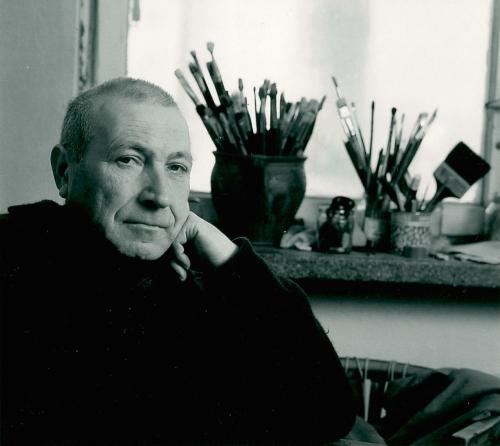
Stefan Gierowski in his studio on Gagarina Street in Warsaw, 1990s, photo: Archive of the Stefan Gierowski Foundation
Stefan Gierowski was born on 21 May 1925 in Częstochowa. He spent his childhood in Kielce. From an early age, he displayed an interest in painting and wanted to train in the craft. His father, Józef Gierowski, a doctor, was a painting enthusiast who played an important role in fostering his son’s artistic vocation. His mother, Stefania née Wasilewska, had studied gardening and also encouraged the young Stefan to develop his artistic talents. The creative principle manifested itself in the family also through Józef’s uncle, Antoni Gierowski, a 19th-century painter and draughtsman. Patriotic traditions were an important part of the young artist’s formation.
When the Second World War broke out, Stefan, alongside his mother, joined the Armed Struggle Organization (ZWZ) and then the Home Army (AK), where he participated in underground activities under the nom-de-guerre “Hubert.” In 1941, at age 16, he started studying art clandestinely with Andrzej Oleś, a recognized Kielce-based watercolourist. Three years later, he had to discontinue those studies, having been transferred to the Home Army inspectorate in Częstochowa.
After the Home Army’s dissolution in early 1945, Gierowski moved to Kraków, where he enrolled simultaneously at the Academy of Fine Arts and at the Faculty of Art History at Jagiellonian University. His knowledge of art history proved crucial for his reflections on the possibilities and prospects of painting, opening up Gierowski to modernity. Under the supervision of Wojsław Mole, he wrote a seminar paper entitled “Impressionism as Part of French Culture.”
At the art academy, he initially studied in the class of Prof. Władysław Jarocki, but when his clandestine studies with Oleś were officially recognized, he was transferred directly into the third year of the course. He trained under Zbigniew Pronaszko, an ex-Formist, as well as in the class of Karol Frycz, where he studied painting in architecture and designed stage sets. His training and conversations with Frycz acquainted him with the modernist art of the Young Poland movement. In Pronaszko’s class, his fellow students included Zbigniew Grzybowski, Jerzy Panek, Stanisław Wójcik, and Andrzej Wróblewski.
During his studies, Gierowski struck up a collaboration with the literary/cultural magazine Wieś, publishing articles on art and illustrating a number of issues.
In 1948, having completed his studies, Gierowski returned to his native Kielce, where he started working as a specialist in the fine arts at the Department of Culture of Kielce Province. He also ran an arts class at the local branch of the Association of Polish Artists and Designers (ZPAP).
In 1949, offered a permanent position as technical editor of Wieś, Gierowski moved to Warsaw. On behalf of the periodical, he participated in a conference on artistic education held by the Ministry of Culture and Art in Poznań. In June that year, he met Władysław Strzemiński at the National Museum in Poznań. Also that month, the ZPAP Congress convened in Katowice, with Gierowski as delegate of the Kielce branch, where the organization’s takeover by the communist Polish United Workers’ Party (PZPR) began, leading to restriction of Gierowski’s rights as a member.
The following years saw Gierowski devote himself to family life, with his marriage to Anna Golka and the birth of their two children, Magda and Józef. During that time, besides remaining active in the field of painting, the artist illustrated novels by his friend and fellow Kielce native Edmund Niziurski, such as The Book of Urchins. But financially it was a difficult period, living in a “kolkhoz” flat and not exhibiting because his paintings did not meet the criteria of socialist realism. The family survived on his wife’s modest salary as a dentist. In late 1951, Gierowski got a job in the portfolios and art books section of the publishing company Wydawnictwo Artystyczno-Graficzne. He maintained an acquaintance with Marek Włodarski, through whom he later met the members of the painting collective Grupa 55.
In 1955, with the Stalinist order already thawing, he took part in the International Young Art Exhibition at Zachęta in Warsaw, where his painting I Love Life! won 2nd prize. This put him in the spotlight and led to his recognition as a leading painter of the new generation. That status was reaffirmed by the work Pigeon House (1955), which was shown in the 6th Warsaw District Exhibition that year, winning critical acclaim.
Also in 1955, Gierowski participated in the Nationwide Exhibition of Young Visual Artists Against War—Against Fascism at the Arsenal in Warsaw, which proved to be a generational show of artists opposed to the aesthetics of socialist realism. The participants would soon become leading figures in the art of their generation as well as Gierowski’s longtime friends.
In January 1957, the artist exhibited for the first time at Galeria Krzywe Koło, thus initiating what would be several years of fruitful collaboration with Marian Bogusz and the associated milieu. In February, at the ZPAP General Congress, Gierowski was elected the union’s secretary. Together with the newly elected management board, led by his friend Jan Cybis as president, he began working on a new statute for ZPAP. It rejected all political references and socialist terminology, and refocused instead on the reorganization of exhibition structures and art centres. As a result of Gierowski’s efforts, several dozen ZPAP-affiliated exhibition spaces were opened around the country. Also in 1957, a year that proved pivotal for his career, Gierowski embarked on a series of paintings designated by Roman numerals. The first of those featured in the 2nd Exhibition of Modern Art at Zachęta, earning him wide critical acclaim, including from the prominent poets Julian Przyboś and Zbigniew Herbert.
In the following years, Gierowski, alongside Aleksander Wojciechowski and Marian Bogusz, was elected to the organizational committee of Confrontations 1960, a Krzywe Koło event that was recapitulated on 8 September 1960 during the 7th Congress of the International Association of Art Critics (AICA). With Bogusz and Wojciechowski, he was responsible for the programme of Confrontations as well as exhibiting his works in one of the shows.
In the late 1950s and early 1960s, Gierowski frequently exhibited abroad, participating for example in the 1st International Biennale of Young Artists in Paris (1959), the 5th International Biennale of Contemporary Art in São Paulo (1959), and the exhibition 15 Polish Painters at the Museum of Modern Art in New York (1961).
Following the success of the Polish presentation at the Paris Biennale, he was invited to stage a solo show at Galerie Lacloche, which opened in April 1961. The same year, at the urging of Marian Wnuk and Jan Cybis, he joined the faculty of the Academy of Fine Arts in Warsaw to teach painting in architecture in the department headed by Aleksander Kobzdej.
Soon, in 1965, he was granted permission to start his own class. His teaching style was friendly and open, with a curriculum based on general painterly issues, such as colour and gene. Over a hundred students completed his course, including such figures as Marian Czapla, Jerzy Kalina, Łukasz Korolkiewicz, Ryszard Ługowski, Jarosław Modzelewski, Marek Sobczyk, Antoni Starowieyski, Krzysztof Wachowiak, and Apoloniusz Węgłowski. In 1975–1981 Gierowski served as dean of the Faculty of Painting, and in 1983 was elected rector of the academy, but the authorities objected and he never took up the post. He served on the Organizational Committee of the Congress of Polish Culture in 1981. In 1982–1988, he was a member of the Chief Council of Science and Higher Education, and president of the Council of Higher Artistic Education. He was promoted to full professor in 1986.
Ten years later he retired from teaching, and thereafter lived and worked in Konstancin-Jeziorna near Warsaw.
The Stefan Gierowski Foundation was launched in 2014. Besides popularizing and protecting the artist’s oeuvre, it supports young painting through the annual Foundation Prize. It is also an active exhibition venue, organizing survey shows devoted to various aspects of contemporary and 20th-century painting.
Stefan Gierowski died in 2022 at the age of 97.