I'm here, and I know what I need to do / Estera Mrówka, Julek Wierzchowski, Marlena Biczak, Monika Szydłowska, Paweł Krzywdziak, Witold Winek
Pawilon Bliska 12
18.09.2026 - 27.09.2026-
Selection of works: Julian Wierzchowski (textile), Monika Szydłowska (woodcut), Paweł Krzywdziak (installation), Marlena Biczak (object), Estera Mrówka (object), Witold Winek (monotype) -
Selection of works (details): Julian Wierzchowski (textile), Monika Szydłowska (wood relief), Paweł Krzywdziak (copper engraving), Marlena Biczak (mezzotint), Estera Mrówka (drawing), Witold Winek (relief print)
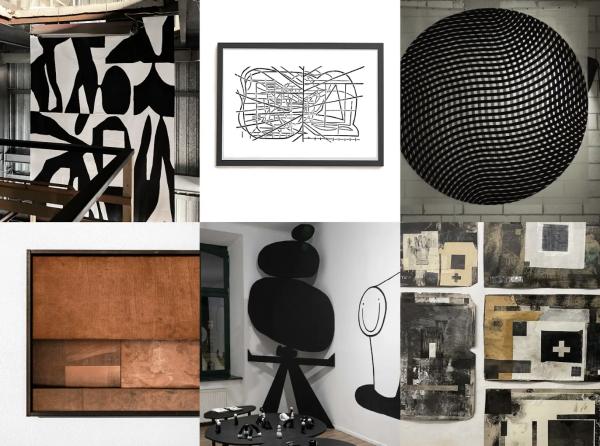
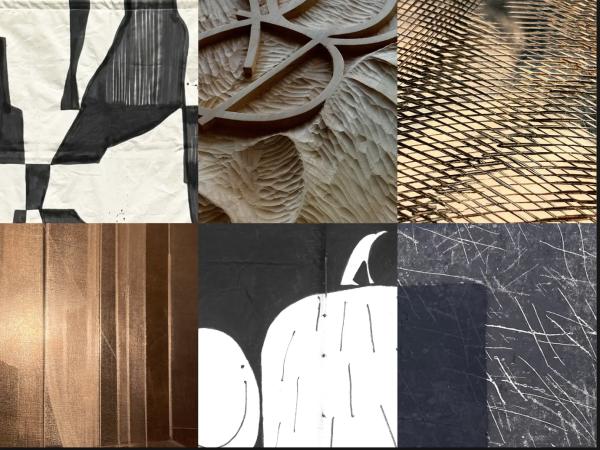
Ladies and Gentlemen,
What we are doing here is, in a sense, an experiment. The curator—the person writing these words—works in a completely different field of art. In short: I know next to nothing about the craft of printmaking. Yet this encounter is far from accidental, because what we want to do is talk about printmaking without actually talking about printmaking. And who could be better suited to such a task than someone who simply does not know the craft?
In our conversations, one question kept resurfacing: is it possible to describe an exhibition of printmaking without discussing the workshop itself? Can printmaking have a subject entirely external to the medium? After all, in this discipline the medium always comes first, while the subject gradually emerges through countless hours spent in the studio—almost the opposite of what one might expect. At first, writing this text seemed like an impossible task, one almost destined to fail. Yet, if you are reading these words, you already know that I decided to take it on.
What defines the practice of the E/A Collective above all is the duration of the process, the high threshold of entry, painstaking labour, perseverance, repeated failure, constant exercise, and endless repetition. One might easily mistake this for a description of an aspiring athlete's training—and perhaps that would not be entirely wrong. The comparison with sport is, in fact, surprisingly apt. Like athletes, the artists continually refine their craft, striving for technical mastery. Paweł Krzywdziak describes printmaking as a contemplative medium, while Marlena Biczak finds in it a meditative quality. Training, repetitive movements, precise timing, confidence, and mastery of technique all contribute to the best possible result. As Julian Wierzchowski points out, works of graffiti created in distant locations carry a particular value—rather like an away goal in football, which somehow always counts for more. Even injuries belong equally to both professions: calluses, back pain, puncture wounds, splinters lodged beneath the skin, and toxic fumes. According to Wolfgang Welsch, contemporary sport has become an activity situated within the realm of aesthetics rather than ethics, making it fundamentally akin to artistic practice.
The slowness of the technological process strikes me as almost exceptional in an age of late capitalism, when time seems to accelerate exponentially: information overload, the colonisation of attention, fast fashion, fast life—constant doing, producing, consuming, preferably twenty-four hours a day, seven days a week. This overstimulation and perpetual dopamine rush seem, remarkably, to bypass this particular branch of artistic practice. Artists working in printmaking probably spend more time face to face with their works than anyone else. As Pablo Picasso famously said, "When inspiration comes, it finds me working." The exhibition's title, I Am Here and I Know What I Have to Do, is not only a declaration but also an accurate description of what takes place in the print studio.
At the same time, the artists attempt to move beyond the workshop's comfort zone. This is no simple task, because the workshop is demanding: it consumes time, dominates attention, and jealously refuses to let go. Polishing, carving, etching, grinding, incising, pressing—these actions define the rhythm of the studio. The collective's intervention lies precisely in making visible what usually remains hidden: printing matrices, copper plates, wooden blocks, and the physical forms employed throughout the printing process. Viewers do not simply encounter finished images; instead, they step backstage, entering a space saturated with process. The material traces of labour become an analogue for the contemporary experience of excess: perpetual activity, production, and transformation.
Yet although the process itself requires considerable physical effort, it also offers relief from the overload imposed by contemporary life. The outcome of artistic work is not merely the finished object but the release of accumulated weight—a sense of liberation, of lightness.
The exhibition I Am Here and I Know What I Have to Do brings together prints, installations, sculptures, video works, textiles, and graffiti.