Thoroughly
Turnus
to 28.02.2026-
Thoroughly, exhibition view -
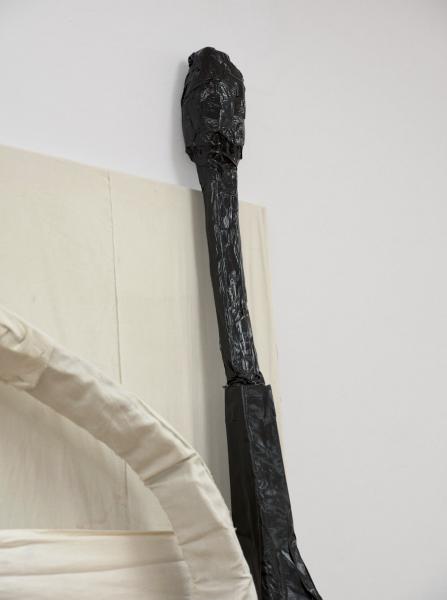
Trin Alt Untitled (from series Things), 2025 spruce, cardboard, cotton, paper, pins, tape, acrylic paint 200 × 90 cm -
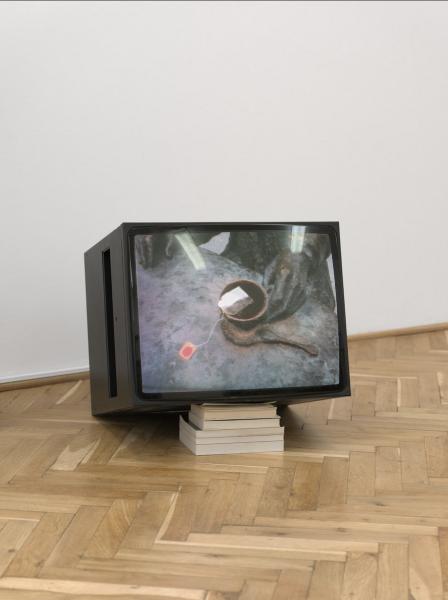
Cezary Bodzianowski Ronin, 2025 film, camera operator: Sławomir Pękala Edition 1/3 + I AP -
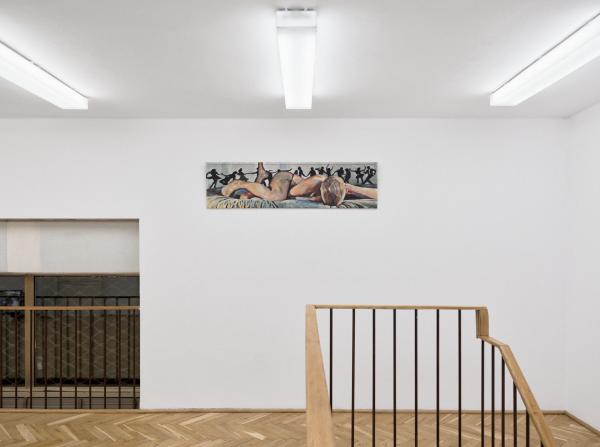
Kuba Stępień bed girl, 2025 pastels, pencil, crayons, own ink transfer technique on corkboard 40 × 150 cm
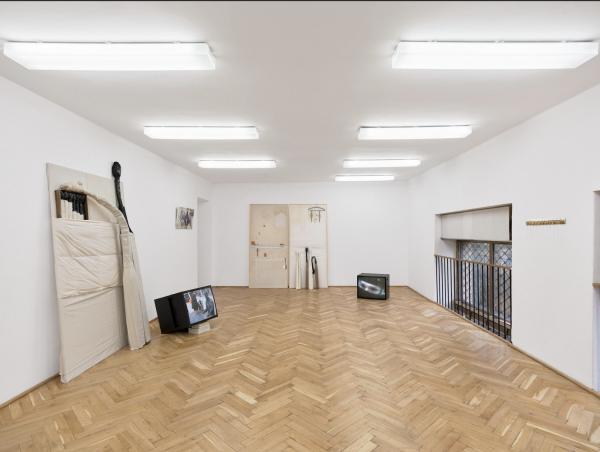
Trin Alt, Cezary Bodzianowski, Kuba Stępień
I see ordinary things differently – thoroughly – when I realize what they remind me of. A cardboard folder, an empty pill blister pack, a bright egg carton – their material value is negligible, but the penetrating power with which they affect me is disproportionately sharp, violent, and magical. Meanwhile, I don't register the presence of other objects at all – those that are very close, everyday, utilitarian. I don't see what I do with them, nor what they do to me. Very often, it turns out that it is precisely these objects – whether I want it or not – that construct an image of me, co-creating or even reflecting my identity.
The exhibition title refers to a method that – in various contexts – might have been adopted by Trin Alt, Cezary Bodzianowski, and Kuba Stępień. "Na wskroś" means "thoroughly," "completely," "to the core," "from beginning to end." In the context of the exhibition, it refers to a way of perceiving and experiencing both overlooked, incomplete, or destroyed things, and the associations and contexts that have accumulated around them. It defines a perception that recognizes and appreciates the narrative potential contained in ordinary objects.
In Cezary Bodzianowski's works "Numbers and Measures" and "Metro" – characteristic of the artist's practice – discolored, used tea bags are arranged in rows. In the first work, the tea bag papers align with all their edges, as if they had been placed back into their factory packaging. The concertina structure formed from them, with strings and knots protruding, is suspended above a plastic dustpan, which suggests an inevitable transport. In "Metro," dried tea "rats" are carelessly crumpled into the holes of a metal frame shaped like a train car. The bags touch chaotically, as if fighting for their space. The hanging, irregularly spaced strings resemble a measuring tape. In practice, these are works entirely made from everyday life. The artist often interferes with its rhythm, extracting poetry from the most prosaic objects. He seizes upon what is familiar, yet often too transparent, too banal, to be fully noticed.
Routine is, contrary to appearances, full of metaphors that leave it open to associations. Although it does not itself take any physical form, it reveals its existence in automatic behaviors or ways of operating, often acquired through repetition. The domestic space and the objects gathered within it are, in Trin Alt's art, a starting point for weaving narratives about the subjective experience of home and routine. Alt creates assemblages from used sheets, pillowcases, duvets, and other fabrics, as well as objects made of cardboard and plaster. Reduced to pictorial form, the objects cultivate a discreet memory of the users of the stained and worn textiles. Simultaneously, like urban landscapes, they make everyday life seem much larger, and thus more impressive, than it might appear at first glance.
Frequent, conscious shifts in perspective make daily life a dynamic source of inspiration, intention, and new possibilities. Kuba Stępień lived and worked in her hometown of Bełchatów this summer. The foundations for her works from this period, besides canvases, were sewing materials found in the attic, as well as cork boards. The latter, associated with the early school experience, have no inherent qualities in themselves – it is agency that gives them their unique character. Stępień recorded scenes on them that carry the emotional charge of her surroundings and the universality of motifs from life. She used her own technique of transferring ink onto the surface using glue and saliva. Although some of these works are group portraits, in essence they still constitute a form of self-portrait. The unsettling effect likely stems from an "outsider" perspective. It reflects a position chosen by artists who define their practice through transgression—defying both societal norms and their own ingrained creative patterns.
To some extent, it's easy to confuse this concept of perceiving and experiencing something thoroughly with "seeming" or even "believing." However, one can rather "know" right through, rather than "judge."
Jess Łukawska