The Circle
LETO
-
-
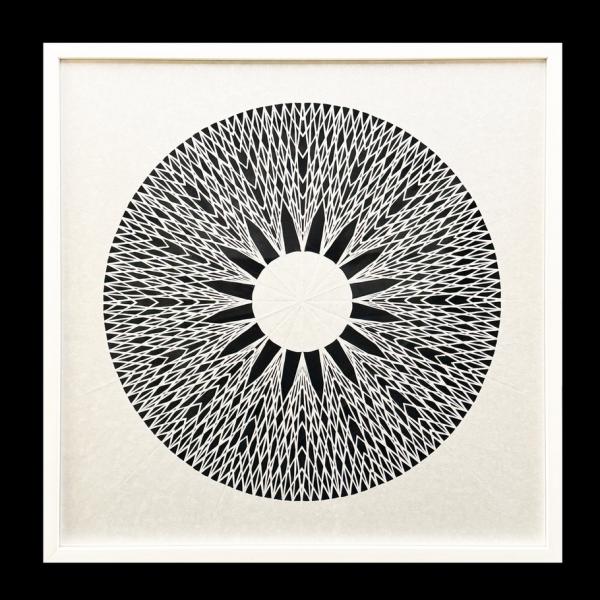
Wojciech Ireneusz Sobczyk Fenomen (1), 2025 papier ryżowy, wycinanka 45 x 45 cm (frame dimensions: 47,2 x 47,2 cm) -
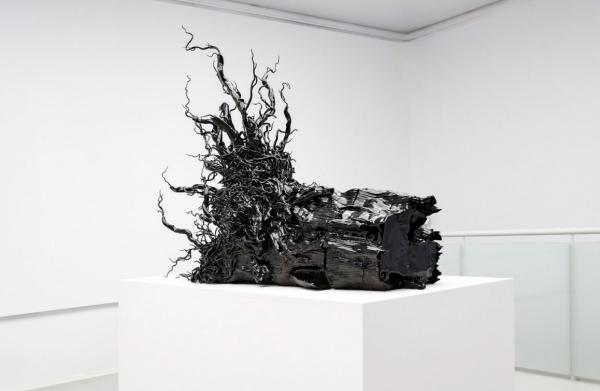
Wojciech Ireneusz Sobczyk, Trunk from the Danse Macabre series, 2023 ceramics, glaze 130 x 200 x 80 cm
In The Circle, Wojciech Ireneusz Sobczyk makes a purposeful attempt to relay a narrative through more than just a single perspective. He composes a network of linked states of being, momentary configurations in the physical and energetic composition that is in constant flux between these varying states. The starting point is a fundamental material observation: matter is not a static state, but a form of energy and each of its states is temporary, based on the specific balance of energy. In this sense, Einstein's E=mc2 is not simply a scientific formula, but a philosophical key to an entire mode of understanding. It is a subtle expression of eternal transformation that fills each particle of the Universe, from the slightest vibrations to large-scale cosmic shifts, weaving together time, energy and structure in a single, unbroken circuit.
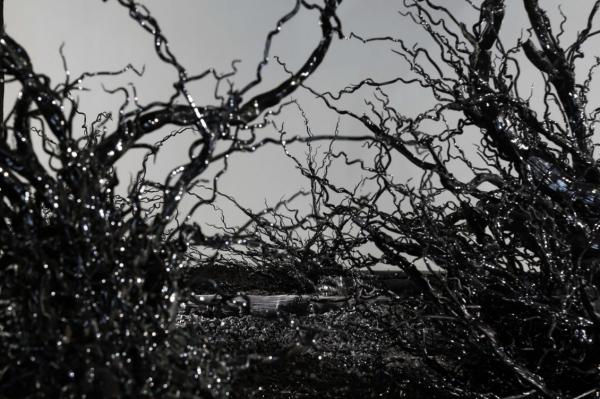
Sobczyk constructs the space of the exhibition in the form of landscape after a drastic change. Ceramic trees lie on the charcoal ground, bringing about the image of a world experiencing the effects of extreme fire, gone past a certain limit that marks the erosion of the nature of the original form, without destroying it fully. Instead, it evolves into a new state of being. The tree, as a symbol of life, growth and organic structure, has been translated into the lexicon of ceramics, which uses heat to transform a material into a solid, stable form. The coal on the ground stands as a channel of memory: a substance that contains the physical traces and energy of the past, while also representing the force of destruction behind its transformed state. The tension between these two materials, ceramics and coal, shed light on the complexity of these transformative processes, engaged in a perpetual confrontation between permanence and disintegration.
The narrative thread running through the exhibition doesn't just pertain to the material state. These symmetrical, spherically shaped cut-outs bring an abstract order to the space, in deference to the laws of physics that describe such circular motions as patterns that keep systems and structures in balance and their repetition. The circle, with no beginning and no end, becomes a symbol of a perpetual return, where time loses direction and matter and energy spin around in a self-contained circuit of existence. The cut-out technique itself is understood as an act meant to do away with all that is superfluous to reveal the underlying order. Paper as a material is also essential here, as it's another carbon-based source. The cut-outs also reveal the paradox inherent across the exhibition. Despite their fragility and impermanence, they still serve as a solid tool for manifesting the laws around the most significant structures in the Universe. Matter is not a channel for external meanings, but a meaning in and of itself, revealing the rules that govern its state of being.
The Circle is an installation where ceramics, light and matter face off, shifting the emphasis toward energy. Ceramics, with its highly pure and stable chemical composition, showcases the effects of light and its role in transporting energy and information. These projections on ceramics are visual in nature, while also introducing ideas and reflections on the limits of perception and the relation between time and energy. Sound rounds out this sensory experience: a regular, slow tempo-ed rhythm that is reminiscent of a pulse. This is a reference to the laws of resonance, essential in describing a multitude of physical phenomena. In the metaphorical sense, this is the universal pulse, running through all matter through time and existence.
All of these aspects are brought together inside the order of the circle, a closed structure that plays host to the flow of energy. A circuit where heating, burning, cooling, crystallization, deterioration, transformation and renewal are all phases of a single process. In The Circle, matter doesn't ever disappear, it only changes form. Coal and ceramics, light and sound, mass and energy all comprise a common system where creation and destruction are inextricable.
Sobczyk's practice doesn't offer any unilateral interpretations. Instead, the exhibition welcomes viewers to consider the world as a continuous order, where every end is also a beginning, where each momentary change is an essential piece in the perpetual cycle of transformation.
Text: Monika Sadowska
Partners of the exhibition:
Wozownia Art Gallery in Toruń
BWA Art Gallery in Olsztyn
Photos courtesy of the Wozownia Art Gallery in Toruń / photo by Mateusz Jagielski
LETO
Dzielna 5
Warszawa
00-162
- monday
- Closed
- tuesday
- 12:00 pm - 6:00 pm
- wednesday
- 12:00 pm - 6:00 pm
- thursday
- 12:00 pm - 6:00 pm
- friday
- 12:00 pm - 6:00 pm
- saturday
- 12:00 pm - 6:00 pm
- sunday
- Closed