Importance of the names
Stereo
-
Barbara Wesołowska -
Barbara Wesołowska
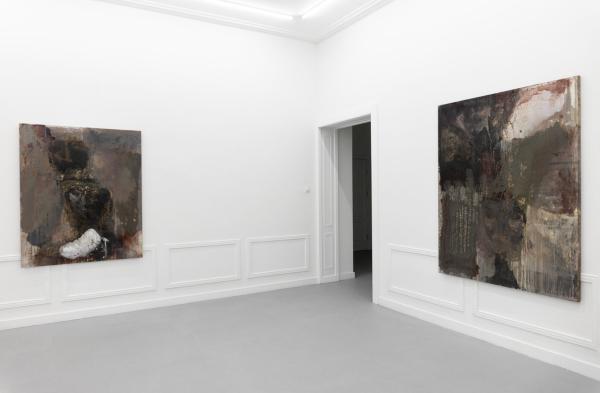
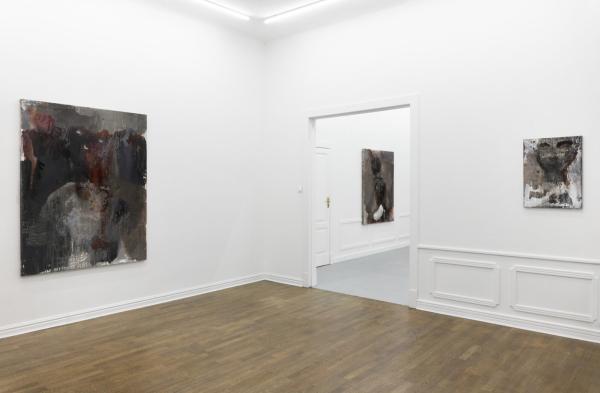
They are images but they are not images. They are faces and bodies, one or two sometimes more, but they are abstractions, non-figurative, depending on the angle or the light or even the mood or the day and definitely on the viewer because, of course, how else is a work of art ever seen. They are paintings but their surfaces both exceed and diminish flatness, use additive and subtractive processes, positive and negative space to carve out whatever it is you might apprehend, in any given flickering moment, in their enigmatic surfaces and veiled palette. We are gold, purple, brown, crimson, mauve, grey, white, black, violet, ochre, they seem to whisper; we are paint but also raw pigment, because hues can be dusted, take on a special grainy sheen and texture, delicately raised; we have depth, fore and background, but we are precious — as in exquisite, ethereal, sacred — and our perspective is arrested where this quality arises: gold leaf — the purest, holiest flatness, it exists in no plane but its own, simultaneously absorbs and reflects light, stops us in our tracks and winks, glints, seduces.
I have, I realise, anthropomorphised these six paintings of varying sizes by the Polish artist Barbara Wesołowska, but this is the tendency when sometimes sits so carefully in a space of indeterminateness: images that challenge what you see and why and how and who and the manner in which this can shift in an instant, throwing your vision back upon itself. The mind reaches for what it knows: faces, bodies, groupings, atmospheres, a hint of something underway even if frozen in place for this moment, and the next, and the next. For Wesołowska, the paintings contain figures, but they are more like fleeting energies than individuals, more like the presences and personages that appear to us in dreams and memories, in which people merge and shift, can be infused with each other, multiply and even disappear, morph from lone individuals into dyads, triads, the energy in the grouping changing seamlessly before us.
This is, I suppose, like the act of looking at the world around us: it doesn’t stay still, we read patterns, learn to recognise familiarity, only for it to pass us by and show something new. Nothing, no matter what or how we wish, stays the same. Matter is both insubstantial and real, tangible, there to make meaning with even as when precision evades us, ineluctably. Wesołowska’s paintings make manifest this overwhelming sense of something having been gained and lost all at once. Beholding them is to feel both senses at the same time, which is to say it is much like living in the world, which poses only questions and not answers. “The stains travel,” says Wesołowska of how the paintings are imbricated by not only form but colour, texture, sympathetic vibration.
We might call this openness something like negative capability, made so famous by the Romantic poet John Keats, who described it as being “capable of being in uncertainties, Mysteries, doubts, without any irritable reaching after fact and reason.” Can one find “fact and reason” in paintings or images in any case? The best art, like the best writing, so often deepens complexity rather than clarifying it. A sense of elusiveness, something just out of grasp is essential, even when difficult: something lost, grieved, wanted, sought, dearly loved, imagined, dreamed, perhaps, most of all risked. “Risk is a battle whose opponent we do not know, a desire of which we have no knowledge, a love whose face we do not know, a pure event,” writes Anne Dufourmantelle in her book In Praise of Risk, from which Wesołowska draws the title of her exhibition, Importance of the names.
The painter routinely waits until a show has come together and pulls names and titles out of materials to hand that are important to her thinking — not necessarily about the specific works, but about her wider practice. In this exhibition, the work titles come from texts by Freud, who wrote that “our nurseries are full of ghosts.” To Wesołowska, this rhymes with “the importance of names,” a sense, maybe, of how something solid can still be transferred between individuals, times, places. That we carry one and replace each other, and ourselves, like hungry ghosts, with every iteration. In this sense, the texts of Freud are also worn like portable names, cloaks thrown over new images and contexts to elicit a new frisson in combination: Being in secret, Reconciliation, Previous Time, Omission, Curtain, Little by little. The space between the name and the name, the image and the image, the artist who made it and the person who views it, is a space of lost but also newly generated meaning — even for Wesołowska. “The paintings are the symptom that doesn’t get traced back to the memory,” she says, of the work, throwing it out to the world of us to feel it, this strange spreading stain, ourselves.
Emily LaBarge is a Canadian writer living in London. Her first book, Dog Days, was published by Peninsula Press in 2025.
Stereo
Tamka 37/1
Warszawa
00-355
- monday
- Closed
- tuesday
- 12:00 pm - 6:00 pm
- wednesday
- 12:00 pm - 6:00 pm
- thursday
- 12:00 pm - 6:00 pm
- friday
- 12:00 pm - 6:00 pm
- saturday
- 12:00 pm - 6:00 pm
- sunday
- Closed