Hanna & Gabriel Rechowicz
Import Export
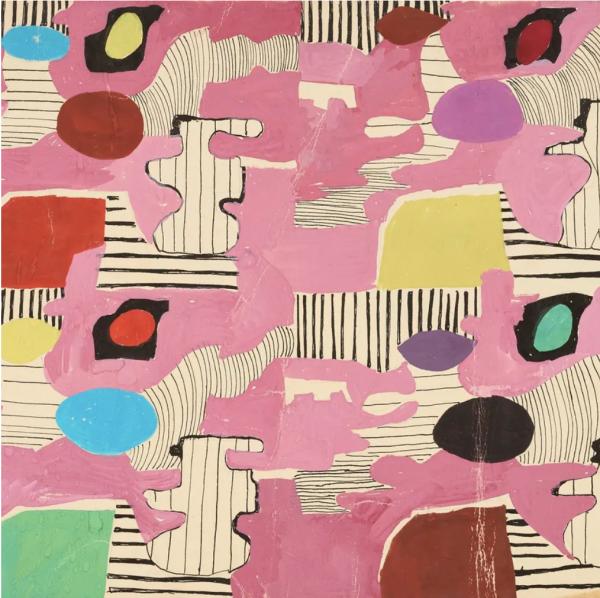
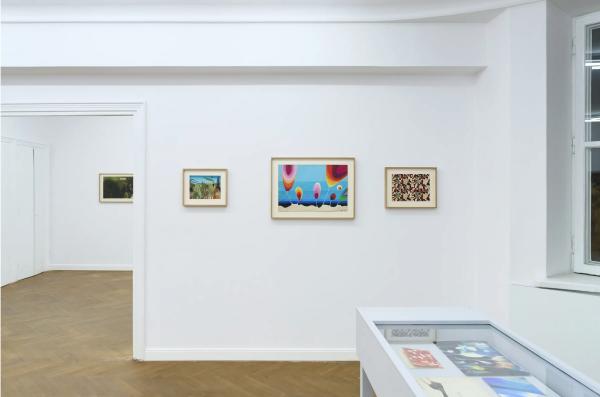
Import Export is pleased to present the exhibition devoted to the post-war artistic practice of the legendary duo Hanna and Gabriel Rechowicz. The exhibition brings together works produced between 1960 and 1980, including studies and models for public commissions, textiles, paintings, objects and collages, created both collaboratively and individually. While Hanna’s practice gravitated toward mosaics, scenography, and textile design, Gabriel worked primarily with fresco, painting, graphics, and illustration. Active at the height of the Polish People’s Republic, Rechowiczowie developed an expansive, interdisciplinary approach, across media and materials, often travesting disciplines within a single project or commission.
During their lifetime, Hanna and Gaber worked closely with leading Polish architects, including Bohdan Pniewski, Jerzy Hryniewiecki, Mieczysław Gliszczyński, Jerzy Baumiller, and Maria and Kazimierz Piechotka. Their cross-disciplinary collaborations, operating within the framework of applied arts, led to multiple public commissions awarded to the artists through the Fine Arts Workshops all over the country.
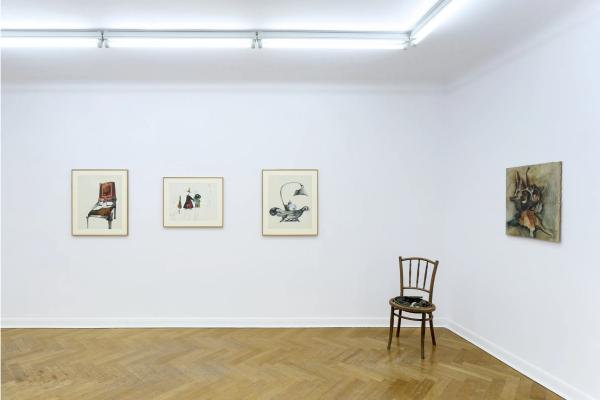
The exhibition unfolds across three rooms. The first examines Gabriel’s practice on canvas, presenting a group of paintings from the 1970s alongside his mosaic-like poster for Polska. The second room is dedicated to the couple’s collaborative practice, bringing together bespoke woodwork, copper-embroidered textile, fabric design, and fresco studies that reflect a shared approach to material and form. The final room focuses on Hanna’s independent work, highlighting her collages, paintings, and objects from the 1960s. As per Max Ciegielski, the author of “Mosaic: In the Footsteps of the Rechowiczes" – the adjective “practical” is, in Hania’s mouth, the worst epithet. It is bad if “something” serves “something,” if it serves “some purpose.” Good and beautiful are impractical things, and thus deprived of any influence on reality. Objects made in order to make them, not even in order that they might exist. What counts is art for art’s sake, action for action’s sake, life for life’s sake.
This philosophy – privileging beauty over utility – permeates the couple’s artistic language, developed across four decades. Often described as colourful birds living in a grey reality, Rechowiczowie pursued a career markedly distinct from the official cultural politics of the Polish People’s Republic; they exhibited primarily abroad, engaged freely with surrealist motifs, and Hanna herself was nicknamed “Mrs. Fantasy” when making the abstract mosaic at the Peasant House in the early 60s. It was made of shiny pebbles (collected from different Polish riverbeds by Gaber), ceramic parts, glass and remnants of glaze, and was housed in the monumental construction funded by farmer’s funds and designed by Bohdan Pniewski.
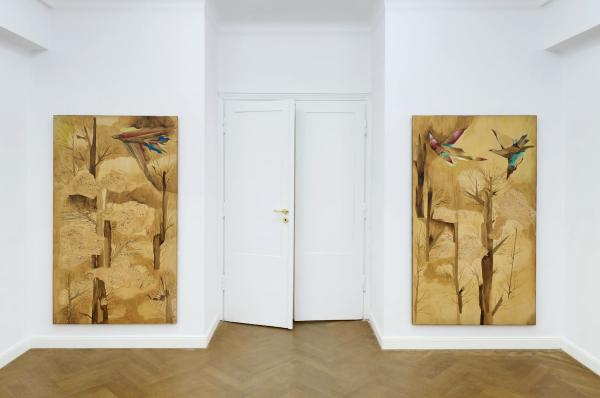
The works presented in the exhibition are evocative of this dreamlike approach; focusing on an abundance of forms and expressions, the “good and beautiful things” appear through decorative jewels on Gaber’s canvases, lively colours in curtain designs, or in forest landscapes from their collaborative wood works. Included in the exhibition are two such custom wooden panels with ornamental detail, which belong to the “Seasons” series designed by Hanna and Gabriel in the 1980s for the health resort in Ciechocinek. The project was never realised on site; the panels on view at the gallery stand as rare examples of architectural paintings – visually ‘raw’ in texture, with fragments of various materials overlapping on the surface. Their composition, featuring brightly coloured birds in a decorative, elongated landscape evokes both escapism and quiet resistance. Those bespoke wooden panels made for a health resort embrace vitality of vision, in a poetic, craft-driven manner.
Small-scale studies and models for city murals and mosaics offer a rare insight into the creative process behind the duo’s monumental public commissions. Among them is the model for Gabriel’s fresco at Bar Frykas in Supersam (1962), previously shown at Zachęta. Jerzy Hryniewiecki – the head of the Superam design team, presented the bar’s empty wall to the couple and invited them to “now go crazy.” Gaber executed a sweeping, surrealist composition in which colour flows through geometric structures, hovering above a wavering horizon. Hand-painted across a surface more than forty metres long and seven metres high, the fresco was conceived to visually expand the space above the bar counter – opening onto an imagined, alternative dimension. Supersam itself stood as a landmark example of modernist architecture in Poland; market halls, popular at the turn of the 20th century, concentrated diverse sectors of commerce under one roof – a rare phenomena in the context of the nation’s communist past. In line with Max Cegielski - bar Frykas was a utopia, a fresco by an artist above the delicatessen – a beautiful dream of an alliance between the people and artists, power and culture, the system of control and beauty.
In the early 1950s, Gabriel assisted Jacek Żuławski at the State Academy of Fine Arts in Sopot, where Żuławski’s workshop of architectural painting promoted an organic connection between architecture and its surface – inviting artists to fill the “meat” of walls with art. According to Paweł Giergoń, the curator of “Hanna and Gabriel Rechowiczowie: Paintings in Architecture”: In their architectural paintings, the Rechowicz duo employed mosaic and painting techniques, often combining them within a single work. The compositions received a unique quality through the choice of material, e.g. carefully selected, natural-colour or artificially coloured river pebbles, tiles or ceramic waste, which, bonded together with mortar, created an abstract relief in the vein of opus barbaricum (...). Many of these large-scale architectural paintings were partially or entirely destroyed following the fall of communism, disappearing amid the lack of conservation oversight in the 1990s and early 2000s. Most notably, these losses concern mosaics and frescos created in the early 1960s for sites such as Hotel Bristol, Peasant's House (now Hotel Gromada), or the no longer existing Supersam building.
Several works on view were only recently rediscovered in the artists’ long-standing studio, located in the attic of a tenement house at Stara Street 11 in Warsaw. Granted to the artists in 1974, this 100-square-metre space served as the site where many of their public commissions were conceived. Hanna’s three collages from the 1960s, displayed together for the first time, were unearthed in the process of preparing this exhibition. They reveal a more playful and experimental attitude to her practice, in which themes concerning ornamentation, architecture, fashion and theatre design come to the fore. In one collage, depicting a seemingly unfinished, royal-looking chair, an art-historical reference to Jacopo Amigoni’s work Peter I with Minerva is navigated in an avant-garde way. Embedded into the backrest, the baroque painting acts more as scenographic material – another element within Hanna’s idiosyncratic aesthetics.
Today, Rechowicz's vision – poised between fantasy and material experimentation – endures as a testament to an artistic practice that continues to resonate, offering contemporary audiences a vision of beauty unbound by function.
The exhibition at IMPORT EXPORT was prepared in collaboration with Hanna Rechowicz and her family.
Import Export
Aleja Szucha 16/7
Warszawa
00-582
- monday
- Closed
- tuesday
- 15:00 pm - 6:00 pm
- wednesday
- 15:00 pm - 6:00 pm
- thursday
- 15:00 pm - 6:00 pm
- friday
- 15:00 pm - 6:00 pm
- saturday
- 12:00 pm - 6:00 pm
- sunday
- Closed