Music for a Panic Attack
Polana Institute
-
Magdalena Karpińska, Brewing the Stem (Narcissus), 2025 -
Magdalena Karpińska, And with horror he understood that at the end of everything only the physical remained, only the teeth and the nails, 2025
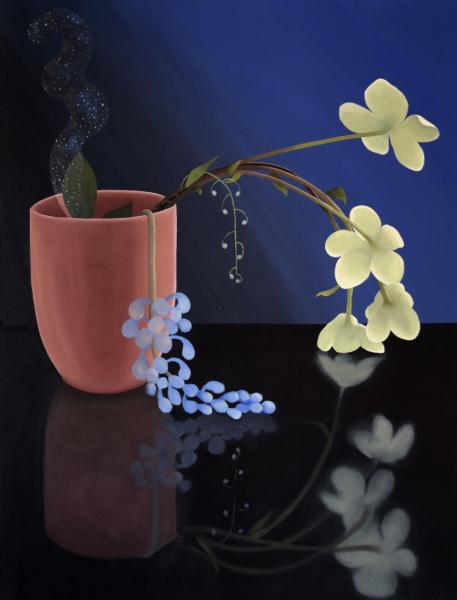
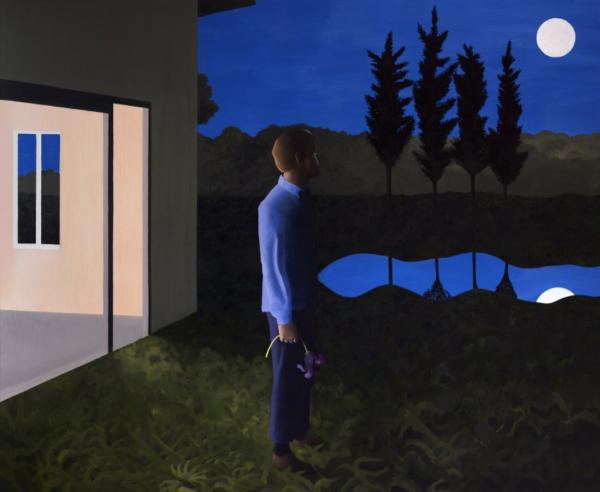
One of the inspirations for Magdalena Karpińska’s latest painting series is tarantism, a cultural and therapeutic phenomenon documented in rural southern Italy, particularly in Apulia, since the Middle Ages. Closely linked to the agricultural calendar and the harvest season, tarantism was associated with the belief held among rural communities, predominantly women, that the harmful effects of a tarantula bite could be cured only through a ritual dance accompanied by music – a form of choreographed exorcism. The bite itself was usually imagined and the symptoms psychosomatic, most likely reflecting states of psychological distress or depression. The dance thus functioned as a socially sanctioned therapeutic practice, offering catharsis and temporary relief for inner suffering.
Karpińska does not depict the dance directly. Instead, she introduces selected attributes associated with the ritual, such as a body of water used by the dancers to wash their faces, a mirror, and the number four, referring to the traditional ensemble of musicians accompanying the tarantella. In the artist’s work, the healing function of the dance is transposed onto the act of painting itself, understood as a process through which a sense of balance and harmony between body and mind may be restored.
Perhaps all the paintings are portraits of a single person. The man, suffering in silence, allows himself solitary nighttime walks and moments of melancholy by the fire. The woman, in turn, tends to a new life as if it were a plant; she exists in a state of constant struggle, overwhelmed by the demands of a changing body, while her emotions remain inaccessible. Despite their apparent differences, both figures seem to share the same inner image – one that shapes their sadness and gives rise to trauma and unwanted isolation.
The still life Music for a Panic Attack carries the weight of mourning for a close person. The woman playing the harp is accompanied by weeping figures, and the still, softly illuminated silk curtains recall the iconography of the shroud.
The inner conflict and refusal to accept a difficult reality experienced by the protagonists ultimately reach an end. This moment is marked by the final painting in the cycle, The Only Way Is Through. A pregnant woman, posed like the biblical Eve, reaches out not for an apple but for a tarantula. She has no choice: to become a mother, she must violently push trauma aside. She may do so more quickly through magic – through the purifying ritual of tarantism – or, somewhat later, with the help of biology.
The deeply personal and painfully honest character of the series is reflected in its formal qualities. Nature in Magdalena Karpińska’s paintings does not grow spontaneously. Every element – each petal and leaf – is rendered with meticulous precision, reminiscent of Japanese woodblock prints. The artist observes their germination, growth, and decay, as if their brief existence were meant to offer answers to other, unspoken questions. This carefully controlled mastery over every centimeter of the canvas is at once unsettling and compelling. It resembles a record of a trance, a visual diary of repressed emotions.
Polana Institute
Stanisława Noakowskiego 16/35
Warszawa
00-666
- monday
- Closed
- tuesday
- 16:00 pm - 7:00 pm
- wednesday
- 16:00 pm - 7:00 pm
- thursday
- 16:00 pm - 7:00 pm
- friday
- 16:00 pm - 7:00 pm
- saturday
- 12:00 pm - 7:00 pm
- sunday
- Closed