Gradual Fading of Control
BWA Warszawa
to 23.01.2027-
Piotr C. Kowalski -
Piotr C. Kowalski -
Piotr C. Kowalski
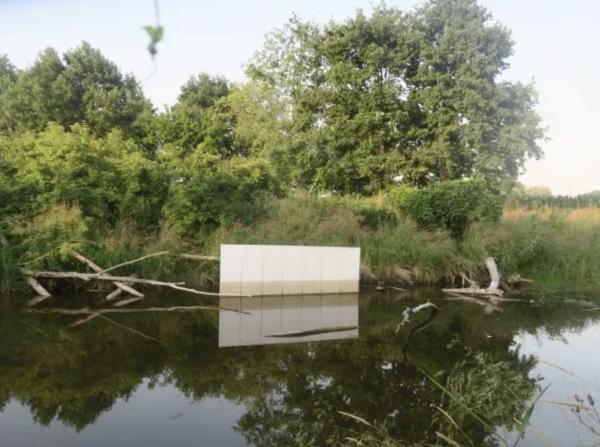
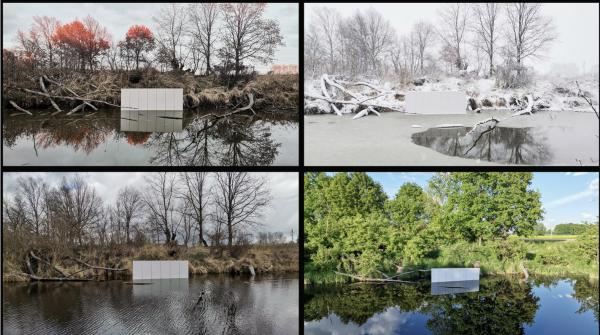
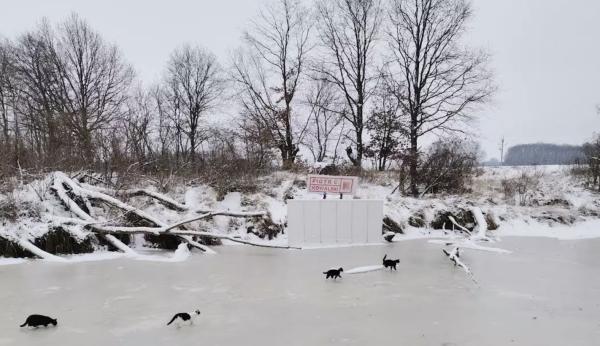
Piotr C. Kowalski’s work can be read as a more than forty-year process of the artist consciously withdrawing from his own art. Initially, C. Kowalski allowed chance into his work, then ever more boldly ceded ground to forces beyond his control, ultimately recognizing their complete independence from him. Against the backdrop of contemporary art world practices, there is something subversive in this: a conscious relinquishing of the self.
Piotr C. Kowalski is a rigorously trained painter. And yet, "amateurs"—anonymous, nameless co-authors of the works—play an increasingly prominent role in his oeuvre. Beavers do not have surnames; they do not seek fame or recognition. Passersby who trample his canvases do not demand co-authorship, the pond does not know it is painting a picture, and trees expect no gratitude for their fruit. All these beings and elements participate in the process while remaining utterly indifferent to its artistic status. It is precisely this anonymity that Piotr C. Kowalski seems to be learning. He gradually limits the presence of his own gesture, allowing his individuality to dissolve into the actions of others. In this way, art reaches its apogee in his hands: it becomes one of the elements—as independent of humanity as wind, water, or the passage of time.
One of the turning points was an incident in 1982, when, during an en plein air workshop in Porażyn, C. Kowalski was picking berries in the forest for his daughter. Only later did he notice signs warning of ground contamination. Instead of throwing the fruit away, he used it to create the painted triptych Still Life (Martwa natura). Chance became the beginning of an artistic discovery: the world itself offers up materials, events, and meanings that the painter could never have planned. From then on, C. Kowalski increasingly allowed gravity, weather, and natural processes to take over. He lays canvases out on the streets, surrendering them to the feet of pedestrians and the wheels of cars. Finally, he submerges stretcher bars in a pond and leaves them there for an entire year. With each successive gesture, his own contribution to the creation of the work becomes less and less visible. The artist gradually removes himself from the center of the artistic event. He consciously orchestrates situations in which his skills give way to occurrences, and art begins to happen on its own.
Encountering this art can be shocking. It is easy to dismiss it as a collection of amusing anecdotes and eccentricities, missing the existential depth hidden within. Meanwhile, C. Kowalski, much like John Cage, follows the trail of one of the most vital intuitions of the human condition. In his famous piece 4′33″, Cage allowed random ambient sounds to take the place of composed notes. By stepping back as a composer, he created conditions in which the world could be heard as music. C. Kowalski creates situations in which the world can reveal itself as painting, precisely because he steps back as a painter. This carries profound implications not only for his artistic practice, but also for the viewer, forcing them to abandon conventional assumptions.
I realized this vividly when I first visited Piotr C. Kowalski in his studio in Nienawiszcz, near Poznań. I caught myself having a rather banal reflex: I was looking around for works that would prove C. Kowalski actually knew how to paint. A traditional, bourgeois notion of the artist had awakened in me—the idea of the virtuoso, the craftsman of the brush who holds dominion over matter. Only after a moment did I realize that C. Kowalski gracefully pokes fun at this very need to demonstrate one's power over the medium. I understood that I was standing before a Master Yoda who no longer needs to draw his lightsaber to prove his mastery. C. Kowalski is already somewhere else—beyond rivalry, ambition, and the need to win. He has achieved a kind of artistic freedom in which mastery is an attitude. The philosophy of François Jullien comes to mind, who points to the potential inherent in the natural course of events and the possibility of acting without imposing a predetermined plan onto reality. C. Kowalski no longer tries to subjugate matter to his will, but rather creates conditions in which it can reveal its own possibilities. Mastery ceases to be about controlling the outcome and becomes the ability to notice and make use of what the world itself has to offer.
As the artist himself put it: I don't want to get in the beavers' way.
Perhaps there is something in this of the humility of a medieval artist, who, in the face of the vastness of divine creation,reconciled himself to his own smallness. For C. Kowalski, the world itself is a sufficient source of this humility—constantly creating, destroying, and regenerating, indifferent to human ambitions and notions of immortality. He voluntarily withdraws his own "ego," adopting a stance close to the philosophy of Simone Weil: in order to see the world as it is, one must, at least for a moment, stop obscuring it with oneself.
Slowly, C. Kowalski learns collaboration. In 2011, he declared a barn in Nienawiszcz to be his largest painting. A year later,the barn was destroyed by a tornado. C. Kowalski did not treat this as the annihilation of the work, but as the next stage of its transformation—this time, by the elements. From the planks scattered by the wind, he began making postcards, which he then covered with stamps and sent through the mail. He did not take offense at the wind; he did not try to undo its work.He accepted the energy of destruction and allowed it to participate.
Zygmunt Bauman saw in his painting an ability to capture rushing nature and preserve its traces - we know this from a letter he wrote to the artist in 1998. Today, we can take this interpretation further: C. Kowalski does not so much freeze a moment on his canvases as he allows nature to record time upon them. In the Nienawiszcz series, time becomes one of the primary painting materials. A canvas left in a pond for a year is a record of changing water levels, temperatures, the activity of organisms, and the passing seasons. Moreover, C. Kowalski does not seal the finished painting with varnish,wanting to preserve the smell of silt and mud—as if accepting that the work still belongs to the world of which it is a part,and that it, too, remains subject to further transformation.
There is one more, perhaps deepest lesson in this practice: consenting to one's own absence. C. Kowalski does not need to manage the process or know everything. He acknowledges that reality has its own history, of which human beings are neither the beginning nor the end. The processes in which he participates began long before him and will continue long after he is gone. In this sense, C. Kowalski’s art ceases to be a way of resisting transience and becomes an exercise in accepting it. Time leads us to fate, and fate to the recognition of our own mortality.
Perhaps C. Kowalski should be read as a shamanic figure, a mediator between the human and non-human worlds? After all, he uncovers before us a world parallel to our own, moving to its own rhythm, indifferent to our affairs. With tenderness and curiosity, he acknowledges its independence. He yields the night to the beavers so that in the morning he can see what they have done in his absence—and shows it to us. Through this, his art becomes a way of healing the relationship between humans and non-humans, restoring a bond with a reality we have grown accustomed to treating as our own property.
As Piotr C. Kowalski withdraws from his art, he returns ever more fully to the world as a human being. Not from a position of power, but as one of life's participants, subject to the same laws of chance, chaos, and transience. He finds freedom in relinquishing the need for control. There is neither despair nor bitterness in this—only wonder, gratitude, and joy in the sheer act of participating in existence. For the brief moment that was given to him.
BWA Warszawa
Marszałkowska 34/50
Warszawa
00-554
- monday
- Closed
- tuesday
- 12:00 pm - 7:00 pm
- wednesday
- 12:00 pm - 7:00 pm
- thursday
- 12:00 pm - 7:00 pm
- friday
- 12:00 pm - 7:00 pm
- saturday
- 12:00 pm - 4:00 pm
- sunday
- Closed