Aleksander Kobzdej
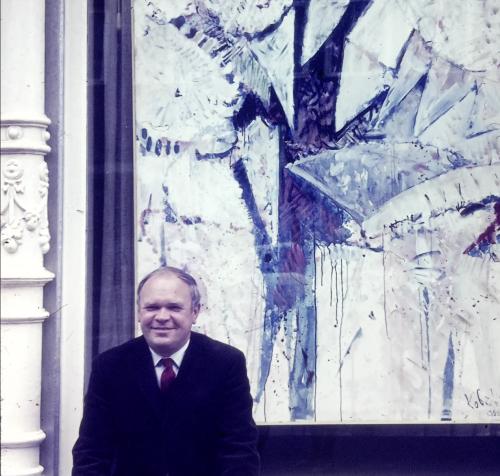
Aleksander Kobzdej, 1966, photo: Małgorzata Starz
Aleksander Kobzdej was one of the most significant figures in Polish art of the second half of the twentieth century. Born in Olesko, he spent his youth in Lviv, where he began studying architecture. He received his degree in architectural engineering from Gdańsk University of Technology in 1945. From 1951 onward, he was affiliated with the Academy of Fine Arts in Warsaw, where he served, among other roles, as Dean of the Faculty of Painting and pursued a long-standing teaching career.
Kobzdej’s oeuvre reflects the major transformations that shaped post-war Polish art. Following an early period of realism and Socialist Realism, in the second half of the 1950s he turned towards abstraction and Art Informel. In the “Idols” series, he developed expressive, biomorphic forms, while in the monumental polyptych “Extermination” of 1964–1965, he addressed the experience of war through dynamic gesture, dense texture and accumulations of matter.
In the following years, Kobzdej increasingly challenged the traditional boundaries of painting. He experimented with movement, producing interactive works and multi-part spatial compositions. From 1966 onward, he developed the “Fissures” series, in which the surface of the canvas was disrupted by openings, cracks and organic structures extending beyond the picture plane.
These explorations led, around 1969, to the creation of the “Hors cadre” series—works situated at the intersection of painting, sculpture and architecture. For Kobzdej, the painting ceased to function as a closed surface and became instead a material, spatial object entering into a direct relationship with its surroundings.
Kobzdej’s work was widely exhibited internationally. In 1959, he received an award at the 5th São Paulo Biennial, and in 1961 he participated in the exhibition “15 Polish Painters” at the Museum of Modern Art in New York. Today, he is regarded as one of the leading Polish artists of the second half of the twentieth century, and his oeuvre played a significant role in the development of avant-garde tendencies in post-war Polish painting.