Magiel
Turnus
to 25.10.2026-
Tomek Tofilski, untitled, 2026, c-print, 24 × 26 cm -
Tomek Tofilski, Dzbanek, 2026, varnished pigment prints mounted on cardboard, wood, staples, 60 × 45 cm -
Tomek Tofilski, Butelki, 2026, varnished pigment prints mounted on cardboard, wood, staples, 150 × 200 cm
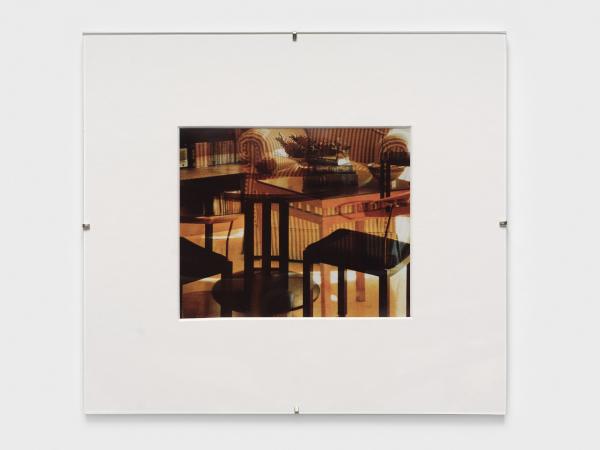
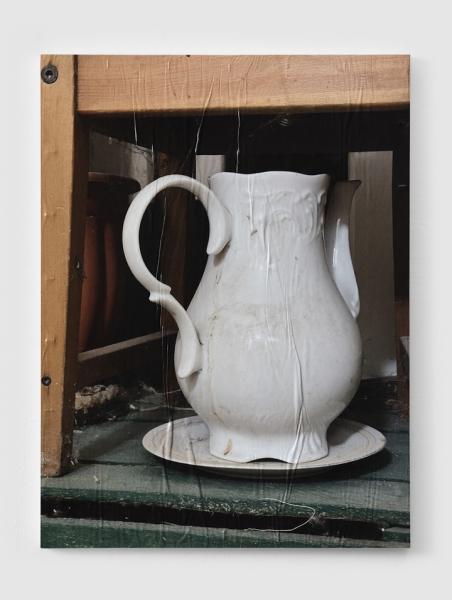
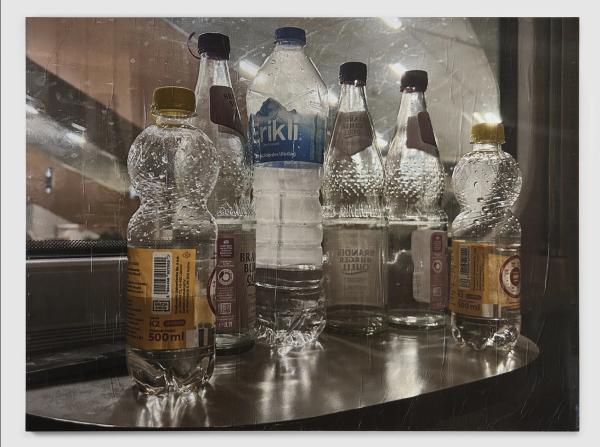
The thing with liquids is that they find the spot that's easiest for them to fill and they fill it with as much of themselves as they can. Sometimes I think of images as liquids and their mediums as vessels. It's funny because puddles are liquids contained by the rest of the world and photographs are views of the world that are later contained within it.
Tomasz Tofilski
The title of the show refers to the site of Tomasz Tofilski’s studio, which is located in a former ironing service in Warsaw’s Praga district. And yet, it is not entirely circumstantial, as the artist’s works do seem in need of a mangle to straighten out their wrinkled and uneven surfaces and bond them with their support. As if the artist himself was unable to stretch them “properly.”
This might seem strange, as his picture-objects are the effect of a laborious and precise process: first, he prepares the support by attaching bookbinding board to a frame made of pine battens using a small amount of glue and staples. Then he prints his pictures on thin technical paper and applies them to the prepared support with a roller and bookbinding glue, as best he can. After a day or so of drying, and further manual processing, he applies 3 to 8 coats of acrylic varnish (drips may occur). It takes about a week for the pictures to cure completely. However, in all their elaborate, archival materiality they remain wrinkled, with drips,”undone.” Why is that?
It is said that to understand the contemporary condition of the photographic image, we need to forget photography as we know it. Unlike the representative photograph, which functioned as a window onto the world, the networked image is a fluid entity, its frame contingent, its meaning dynamically constituted through circulation, context, use, and finally the “data shadow” it accumulates in the course of its life. Tomasz Tofilski’s photographs, inhabiting the infrathin space between the poor image and spam – and seemingly annihilating the photographic gesture – seem to be an attempt at reflecting (on) this condition. They are pure potentiality, materializing as objects by way of the agential cut of Tofilski’s elaborate process. Only in this state can they become theoretical objects, bespeaking the status of the image as container, and the photographic gesture as one of containment, also thematized in the subject matter of watering can and pitcher, water bottles and shower stall. In the case of the latter the relation is inverse: it is the beholder who is contained by the stall, like the puddle by the world. There is no outside and inside, no original and copy, only containment as a moment of holding, of staying with the object as it emerges within a relation.
Dzbanki, a mise-en-abyme, a layering of images (a photo of a catalog page revealing a coffee set with faux wooden structure and rococo landscape “watercolors”), leads us to the other works on display – darkroom contact prints using interior and food design catalogs as negatives. In these small works images overlap and entangle, forming new entities: a latent space of images, coming alive on the retina of the beholder, alternating between the concrete and the abstract. These spaces contain some of the patterns that shape our everyday lives in the way we fashion our environment and the things we consume, arresting but for a moment the movement between gesture and body, image and practice.
As a place of base talk and tasks rather than reflection and refinement, the mangle house occupies a rather lowly rank in the hierarchy of social interaction zones. However, one should not be led astray by the surface of things. When faced with the works, one must concede that nothing is as it seems. Tofilski’s picture-objects invite us to reflect on the relationship of image and idea, texture and trace, matter and thought, window and glass.
Nothing is easy, anything goes. Welcome to the Mangle House.
Text author: Krzysztof Pijarski