Submission of the Human Spider
WHOISPOLA
-
Sebastian Winkler, Sticky Surfaces, 2026 -
Sebastian Winkler, Limbs, 2026
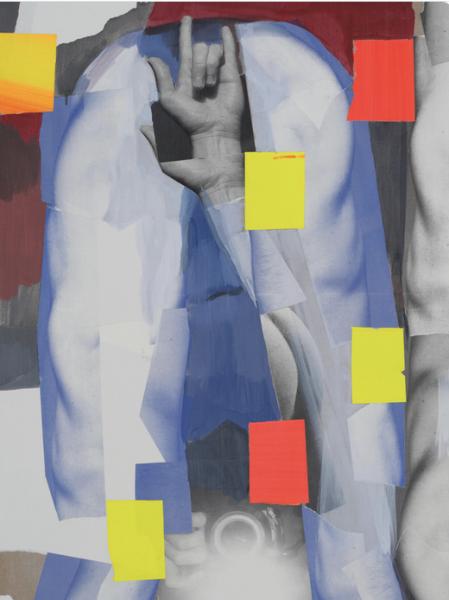
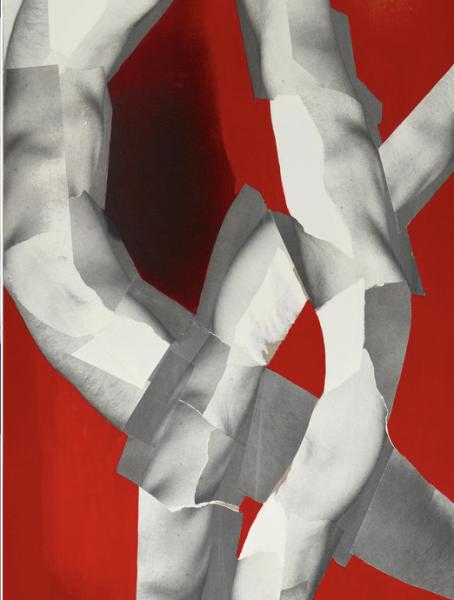
The exhibition features works depicting figures pieced together from pictures of the body, the photographic lens, and the flash. The poses are characterized by a brutal dismemberment that simultaneously allows for the depiction of movement. They thus combine opposing states: the stillness of the depicted bodies and their dynamic kinetics. The vividness of the collages and the emerging dialectic of sticking (understood as stillness) and cutting (enabling mobility) bring to mind the principle of the Human-Spider’s movement from the film Spider-Man (2002, dir. Sam Raimi), which is enabled by attaching the body to architectural elements and then snapping the elastic web at the right moment.
The submissiveness evident in these works is linked to their collage form. Jack Halberstam associates the technique of collage with passivity, highlighting the masochistic nature of such images [1]. Following the American theorist, one can interpret these fragmented representations as eluding simple binary oppositions, in which a queer person is expected to follow a pattern of inversion against the norm. If constructing a coherent vision of the Other relies on fueling their desire for respect and justice, then perverse submissiveness and the pleasure of disintegration emerge as forms of resistance. However, these are not so much about empowering the sense of agency among the excluded as they are about dismantling the norm as an unattainable object of aspiration—about cutting oneself off from the image of oneself as one who is perpetually seeking recognition.
The figure of the Human-Spider, drawn from an American blockbuster, fits into the framework of thinking about collage as a queer technique. In this context, reflecting on visuals allows me to observe their potential role in attempts to conceive of a model of non-heteronormative subjectivity based on evading claustrophobic regimes of visibility. Hito Steyerl notes that representation is always entangled in power structures: it is subject to negotiation and optimization, and thus remains distorted. Similarly to Halberstam, Steyerl proposes a cut off: abandoning representation in favor of invisibility, which she understands as the reclamation of subjectivity [2]. Following this line of thought, the works presented in the exhibition should be considered not as a construction of representation, but as an attempt to dismantle it. Through their jagged nature and their intention to capture the movement of visual fragments, the collages direct the audience’s attention to gaps, cracks, and blank spots.
The idea of escaping representation, as formulated by Steyerl, is very difficult to put into practice. This is because we are, in a sense, bound to images, since we live in a culture constructed according to rules imposed by the sense of sight. Images surround us every day. For marginalized communities, they are an essential tool in the political struggle; at the same time, however, they carry the risk of stifling the public imagination and even reinforcing the status quo.
The photographic lens appearing in the presented images is directed at the images themselves, as if in a gesture of self-reflection. The flash, intended to ensure the fullest possible exposure of the photographed object, also serves as a surgical lamp—exposing the images to the sharpness of a critical eye. While awaiting the results of these operations, we are left with a modest, temporary alternative: looking at ourselves through representations whose otherness manifests in disintegration, dissection, and incompleteness.
This exhibition features a presentation of the latest series of collage works, which is a part of a doctoral dissertation supervised by prof. Maciej Duchowski at the Academy of Fine Arts in Warsaw, as well as a sculpture that was previously exhibited and has been reworked for this new exhibition.
Sebastian Winkler
[1] Jack Halberstam, The Queer Art of Failure, Wydawnictwo Krytyki Politycznej, Warsaw, 2018
[2] Hito Steyerl, The Spam of the Earth: On Withdrawal from Representation, Widok. Theories and Practices of Visual Culture, no. 5: Queer Images, 2014
WHOISPOLA
Londyńska 13
Warszawa
03-921
- monday
- Closed
- tuesday
- 13:00 pm - 6:00 pm
- wednesday
- 13:00 pm - 6:00 pm
- thursday
- 13:00 pm - 6:00 pm
- friday
- 13:00 pm - 6:00 pm
- saturday
- 13:00 pm - 6:00 pm
- sunday
- Closed