Hundred Rising Sun / Attila Csörgő, Jacek Sempoliński, Paweł Zaręba
Monopol
-
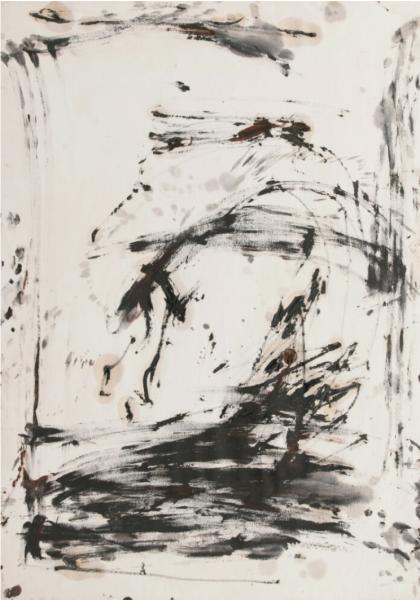
Jacek Sempoliński, Czaszka (Skull), 1995 -
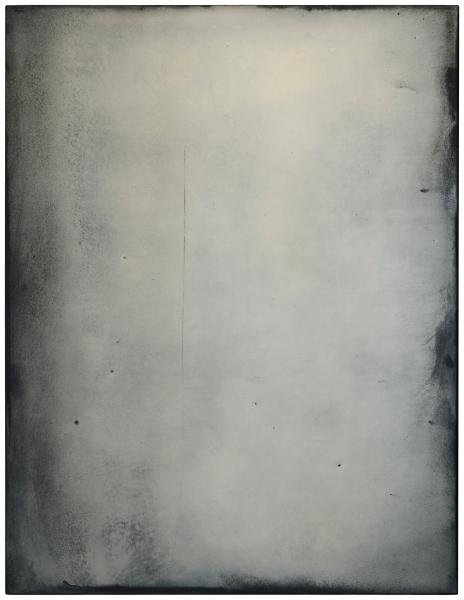
Paweł Zaręba, bez tytułu (Untitled), 2025 -
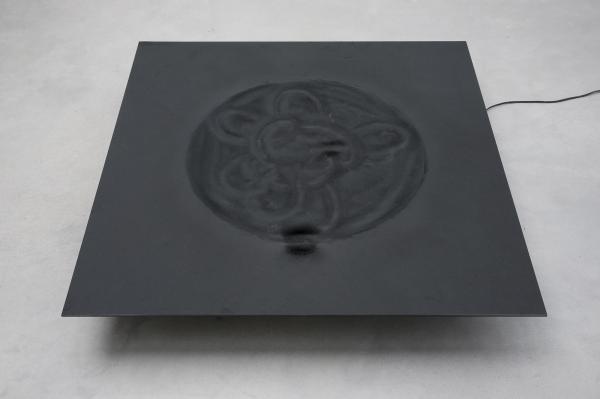
Attila Csörgő, Drawing Machine, 1992
Recalling Theodor W. Adorno’s observation that every genuine artwork is ultimately more intelligent than its interpreter, and taking this remark sufficiently seriously, the prospect of writing yet another text on Jacek Sempoliński’s work seems a risky undertaking. Much has already been written about his painting – Sempoliński himself left behind numerous essays and reflections, formulating his own conception of art and the artist’s vocation. Consequently, attempting another interpretation of his vast oeuvre fills me with anxiety and renders me powerless. Departing from the assumption that any further interpretation will merely repeat what has already been said – often by the artist himself – it may therefore be better and wiser to step back from the role of interpreter. Instead of describing Jacek Sempoliński’s painting in the context of the works of Attila Csörgő and Paweł Zaręba, I will draw on a selection of his thoughts – concerning form, action, and the creative process – and place them in a dialogue with the works of these two artists.
In an essay titled What Is Art to the Artist? [org. Czym dla artysty jest sztuka], Jacek Sempoliński lists three possible creative mottos. He titled one of them Hofmann’s Windscreen Wiper. The painter wrote: “Józef Hofmann (one of the greatest pianists of his era) invented the windscreen wiper. He probably came up with the idea that all one needed to do was turn a metronome upside down in order to use it as a device for wiping a window. Can such a minor detail explain the unique style of this great musician’s piano playing? Who knows. In his generation, Hofmann was the one who restored (or perhaps created?) musical scores as authoritative texts for pianists. Instead of late-Romantic ‘inspiration’, he introduced strict adherence to the text and technical precision […] This windscreen wiper, a small detail, may therefore be important not so much for understanding the artist’s private life as for comprehending art.”[1]
Sempoliński’s insight finds an intriguing continuation in the work of Attila Csörgő, who incorporates everyday objects into his kinetic installations (just as the metronome was an everyday object in Hofmann’s life). For example, he transforms an old gramophone into a drawing machine presented in the exhibition. The Drawing Machine (1992) is based on the simultaneous use of rotational motion and a magnetic field. The interaction of these two forces produces a “drawing” – a trace of movement on the surface of a glass plate covered with magnetic powder. The entire process is unpredictable for the viewer, who can observe the drawing as it continuously changes. Hofmann did not create the windscreen wiper out of romantic inspiration, but rather as a result of practical thinking. In this view, art is not a realm of unrestrained inspiration for the artist, but a conscious and disciplined activity that requires precision, practical imagination, and creative adaptation. Csörgő often constructs devices that reveal movement imperceptible to the human eye, transforms geometric data into spatial objects, or visualise absence. Here, the aim is not always to create an illusion, but to make visible something that was previously purely conceptual – something not directly accessible to perception. A particularly striking example is Inner Spaces (1997), where holes in cheese give form to “what is missing”. The artist’s interest lies in what cannot be seen – beyond the holes in cheese, this includes, for example, time itself.
By applying a humanistic approach to the exact sciences, approaching scientific problems in a playful and poetic manner, conducting long-term experiments, and employing a “do-it-yourself” method based on trial and error, he explores areas such as kinetics, optics, and geometry. Inspired by perspective, geometric forms, and the notions of time and infinity, the artist produces intricate installations that function as dynamic visual experiences He has even claimed to solve the ancient mathematical problem of squaring the circle. Remarkably, Csörgő’s works are taken seriously by the scientific community. For instance, the sculpture Squaring the Circle (2012) is permanently installed at the Astroparticle and Cosmology Laboratory at Paris Diderot University (Laboratoire Astroparticule et Cosmologie, Université Paris Diderot, Paris VII).
When it comes to Paweł Zaręba’s painting, one has to slightly invert Jacek Sempoliński’s reasoning, just as Hofmann flipped the metronome. Hofmann does not create something out of nothing; rather, he transforms an existing mechanism. The metronome remains a metronome, but its motion is put to a different use. Zaręba works within the most elementary means of painting: plane, colour, light, and surface. However, the shifts he introduces – in technology, in the choice of material (he uses Alucobond – aluminium composite panels – rather than canvas), and in the relationship between light and pigment – cause familiar elements to behave differently. Just as in the story of Hofmann’s windscreen wiper, the point here is not a spectacular invention, but a subtle shift in function. Zaręba does not abandon the traditional elements of painting, but subjects them to a significant transformation. The artist employs chemical processes similar to those used to manufacture mirrors, using Alucobond or silver-coated organza as substrates. Pigments, resins, and reagents are mixed in precise proportions, producing surfaces with distinctive optical properties.
Form
[…] I do not wish, therefore, to dwell on what I mean by form; broadly speaking, it is the ultimate goal of art. Form is something that stands at the boundary between the physical world and the non-physical realm, while art, by its very nature, always seeks to cross that boundary or at least to approach it. [2]
[…] in painting, form is something broader and more general – it is the unification of a double pair of antinomies: the flat and the spatial, the material and the spiritual. In this sense, form is simply the entire painting from edge to edge, along with the ambiguity it contains. [3]
Paweł Zaręba’s painting consistently aligns with Sempoliński’s understanding of form. Zaręba’s paintings are neither illustrations of a concept nor visual narratives. Instead, they appear as monochromatic planes in which tension is created through texture, colour, and light. What matters here is not a single gesture or a compositional detail. Rather, the focus is on the entire surface – the painting understood, exactly as Sempoliński described it, as a whole “from edge to edge”. Yet at the same time, this thesis is radicalised by the technique Zaręba employs – layering, chemical reactions, and the careful control of gloss and surface tension. It ensures that the act of painting no longer consists merely in the application of paint. In this respect, Zaręba’s picture ceases to be a Renaissance window and becomes a reflective surface. Form now includes not only the image “from edge to edge”, but also reflection, light, and movement, thereby reshaping the interpretation of the work. Zaręba’s paintings are flat and monochromatic, yet highly expressive. However, thanks to their reflective properties, they take on a spatial quality. Zaręba’s form thus transcends the boundary between “the physical world and the non-physical realm”. The paintings are material objects which – through the reduction of representation and a concentration on surface and colour that shifts depending on the viewing angle and the light – direct attention toward the immaterial. For Jacek Sempoliński, “broadly speaking, form is the ultimate goal of art”. Similarly, for Zaręba, form is not the result of composition, but a perceptual event. In his painting, this idea is realised through a radical reduction of means. Everything that does not contribute to form is eliminated, and the paintings do not construct a narrative. What remains is the experience of the painting as a whole.
In turn, Attila Csörgő starts with abstract concepts – mathematical, geometric, and physical – and then materialises them in the form of kinetic sculptures. What previously existed as a notion or problem is transformed into a spatial experience. If “form is the ultimate goal of art”, it is therefore neither a means, a style, nor a compositional device. The artist does not begin with a definition of form or with predetermined aesthetic principles. His pieces are created through experimentation, from which form emerges – understood not as the shape of an object, but as the cognitive situation generated by the object. This approach is reflected in another work by the artist presented in the exhibition, Hundred Rising Suns. The work Fluid Shapes (2025) is a kinetic video installation inspired by the nineteenth-century photographic experiments on motion conducted by Étienne-Jules Marey and Ernst Mach. It is a complex, multi-element project based on Schlieren optics that combines various fields of physics (wave motion, optics, and refraction), as well as questions of geometry – or, more broadly, the meta-problem of regularity and irregularity, order and chaos, and the creation and dissolution of form, expressed through the language of geometry. Form does not exist here as a permanent object; it only appears when physical phenomena are recorded by the camera. Form is not something that can be predetermined. Waves arise, transform, and disappear, and the forms we see on the screen are merely the transient outcome of dynamic processes occurring in water.
Returning to the story of Hofmann’s windscreen wiper, although Attila Csörgő and Paweł Zaręba employ completely different media, in both cases form emerges through experimentation. In Csörgő’s works, it arises from the effects of physical, optical and geometric phenomena, whereas in Zaręba’s art it takes shape through chemical processes occurring within the material structure of the painting. In both artists’ practices, a shift in function leads to familiar elements behaving differently: in Csörgő’s work, this involves a subversive reinterpretation of concepts/ideas and the use of everyday objects, while in Zaręba’s case it entails a transformation of basic painterly techniques.
And how does this story relate to Jacek Sempoliński’s own practice? At Galeria Monopol, paintings from the mid-1990s (oil on cardboard) are currently on display. These works belong to the Skull series. The artist created them partly using his hands. This direct contact with the material surface of the painting lends them a special intensity: the gesture remains a physical trace of the action, a record of lived experience. This expressiveness is combined with a clear reference to the artist’s way of thinking about painting. Sempoliński once remarked: “My era is that of Mannerism and the Baroque […]. I do not attempt to imitate them, nor do I try to paint in the style of Bronzino, Rembrandt, El Greco, and other painters of that period, whose work is close to my heart. I am a painter of the here and now; it is only through spiritual affinity that I travel back to those times as a kind of model that, incidentally, allows me to see […] contemporary life in a particular way […].”
And further: “‘[…] beyond this realm there is a longing for something quite the opposite – that is, for a dispassionate intellectualism or a cold idealism. In other words, to cease being ‘El Greco’ and ‘Rembrandt’ simultaneously, and instead to become ‘Leonardo da Vinci’ or ‘Piero della Francesca’ – a painter of perspective diagrams, of an intellectualised interplay of visual compositions. Perhaps this path leads more effectively to the core of the mystery of existence than my own dark and emotional approach.”
Agata Chinowska
[1] Jacek Sempoliński, “What Is Art to the Artist?” (1995), in Władztwo i służba (Lublin, 2001), p. 374; trans. by A.P.
[2] Jacek Sempoliński, interview conducted by Ewa Korulska as part of the survey Visual Artists ’84–85, c. 1987; in Jacek Sempoliński: “A Me Stesso”, exh. cat. (Warsaw: Zachęta—National Gallery of Art, 2002); trans. by A.P.
[3] Jacek Sempoliński, “Sztuka inna – sztuka ta sama,” 1974, in Władztwo i służba (Lublin, 2001), p. 349; trans. by A.P.
[4] Jacek Sempoliński, interview conducted by Ewa Korulska as part of the survey Visual Artists ’84–85, c. 1987; in Jacek Sempoliński: “A Me Stesso”, exh. cat. (Warsaw: Zachęta—National Gallery of Art, 2002); trans. by A.P.
Monopol
Marszałkowska 34/50
Warszawa
00-552
- monday
- Closed
- tuesday
- 12:00 pm - 7:00 pm
- wednesday
- 12:00 pm - 7:00 pm
- thursday
- 12:00 pm - 7:00 pm
- friday
- 12:00 pm - 7:00 pm
- saturday
- 12:00 pm - 4:00 pm
- sunday
- Closed