Caprice
Dawid Radziszewski
to 31.01.2026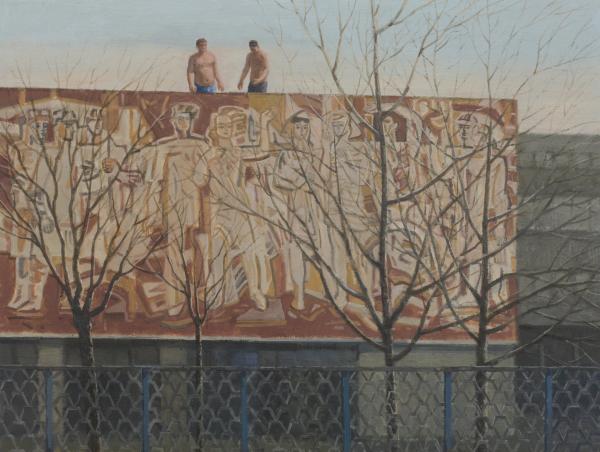
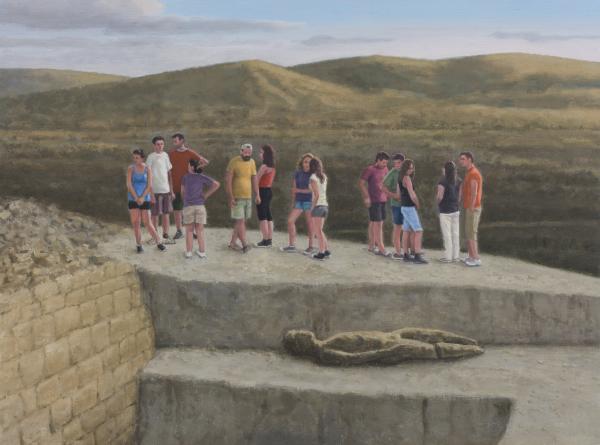
Caprice (it. capriccio) is a genre of painting that originated in Venice and took shape in the 17th century. It fantastically combines existing and partially imagined buildings, architectural elements, ruins, and landscapes. Compositions of real buildings that could never stand side by side, set against the backdrop of atmospheric landscapes, are filled with figures representing all social classes.
Growing up in Romania, the artist had an album by Francesco Guardi, a Venetian painter who died at the end of the 18th century. It was in the pages of this largely black-and-white album that he first discovered “capricci,” and it seems that this genre has remained with him ever since. He adapted it to his own practice, using it as a tool to tell the story of his country’s social changes, its history, and identity.
Şerban combines fragments of the Romanian landscape, views of a country marked by a tyrannical regime clearly expressed in post-war architecture, with motifs drawn from European art history. Romanian identity remains difficult to grasp: politically and geographically, the country belongs to Slavic-dominated Central Europe, but its language and, to some extent, its culture stem from the Western part of the continent. For the artist, capriccio becomes a structure that allows him to freely combine images, ideas, and situations, creating meanings that cannot be achieved separately. It is an attempt to translate a complex local identity into a more universal language of painting.
For the purposes of this exhibition, we have built a structure replicating the layout of our first location on Krochmalna 3, in the Behind the Iron Gates housing estate (Osiedle za Żelazną Bramą). The exhibition closes an important chapter in the history of the gallery – and returning to the beginning, in a context and location that no longer exist – constitutes something of a melancholic caprice.
Şerban Savu (born 1978) – one of the most important Romanian painters of the middle generation, associated with the so-called Cluj School. A graduate of the University of Art and Design in Cluj (2001). In his work, he documents the everyday life of post-socialist Romania, using a muted palette and a realistic, contemplative painterly language. In 2024, he represented Romania at the 60th Venice Biennale.
Dawid Radziszewski
Kolejowa 47a/U13
01-210
Warszawa
- monday
- Closed
- tuesday
- 12:00 pm - 6:00 pm
- wednesday
- 12:00 pm - 6:00 pm
- thursday
- 12:00 pm - 6:00 pm
- friday
- 12:00 pm - 6:00 pm
- saturday
- 12:00 pm - 6:00 pm
- sunday
- Closed